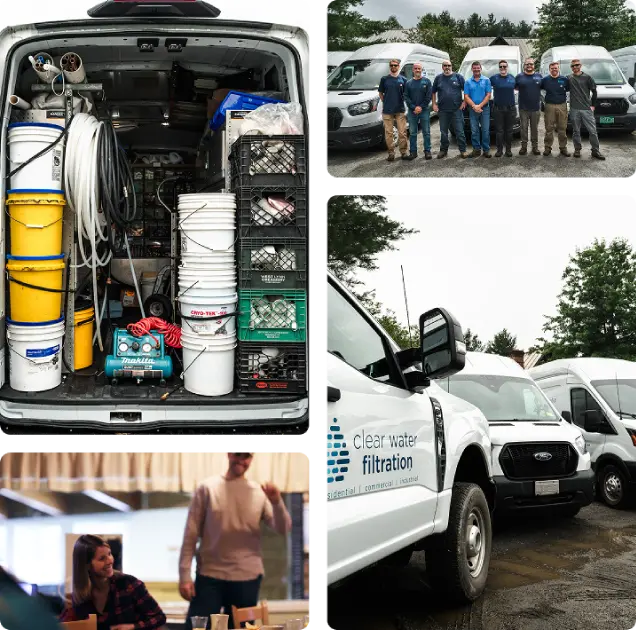
Family Owned & Operated Since 1980



Iron is one of the most common well water problems in Vermont. Clear Water Filtration has diagnosed and treated iron in well water across the state since 1980 - from orange staining in laundry rooms to metallic-tasting tap water in Washington County, Addison County, and Chittenden County homes.
Schedule a Free Water Test Request ServiceVermont Well Water Iron Specialists Since 1980
Vermont's geology makes iron one of the most widespread well water contaminants in the state. Bedrock across the Green Mountains and surrounding valleys is rich in iron-bearing minerals. As groundwater moves through granite, schist, and other iron-containing formations, it picks up dissolved iron that ends up in private wells.
Our team at Clear Water Filtration tests hundreds of Vermont wells each year. Iron ranks among the top issues we find - often alongside hardness and sometimes manganese. The good news is that iron is well-understood and very treatable. The right system depends on how much iron is present, what form it takes, and what other contaminants share the water.
Our well water treatment specialists bring decades of hands-on experience with Vermont's specific geology and well water conditions. When you call us, you speak with a local team member who understands the difference between a drilled bedrock well in Addison County and a dug well in Washington County - and why that matters for iron treatment.
Ready to find out what's in your water? Contact our team to schedule your free in-home water test.
Vermont Bedrock Geology and Iron
Vermont sits on some of the oldest and most geologically complex bedrock in North America. The Green Mountains are built largely from metamorphic rock - schist, gneiss, quartzite, and phyllite - while the Champlain Valley is underlain by carbonate rocks including limestone and dolostone. Both rock types contain iron-bearing minerals that dissolve into groundwater over time.
Drilled wells that tap deep bedrock aquifers tend to have higher iron concentrations than shallow dug wells, because groundwater in oxygen-poor deep formations keeps iron in its soluble ferrous form. Once that water reaches the surface and contacts air, the iron oxidizes rapidly - which is why you often see clear water from the tap that turns cloudy or rust-colored as it sits.
Iron levels in Vermont wells vary widely. Some wells come in under 0.3 mg/L (the EPA secondary standard). Others reach 5, 10, or even 20 mg/L in high-iron areas. Our free water test measures your actual iron level so you know exactly what you're dealing with before choosing treatment.
Based on years of in-home testing across Vermont, our team sees elevated iron most frequently in:
Vermont Well Fact: Iron in well water is not a health risk at typical concentrations, but it causes significant problems with staining, taste, and appliance life. The EPA sets a secondary standard of 0.3 mg/L - primarily for aesthetic reasons.
Understanding Your Iron Problem
Not all iron behaves the same way, and the type of iron in your water determines which treatment approach will work best. Our in-home water test identifies both ferrous and ferric iron so we can recommend the right system for your situation.
Ferrous iron is dissolved in water. When you draw a glass from the tap, the water looks completely clear. But leave it sitting on the counter for a few minutes and it turns rust-colored as the iron oxidizes on contact with air.
Ferrous iron is very common in Vermont bedrock wells because deep groundwater is low in oxygen. In that oxygen-poor environment, iron stays dissolved and invisible. Most Vermont iron problems start as ferrous iron.
Treatment options: Water softeners handle low-to-moderate ferrous iron levels well. Higher concentrations need a dedicated iron filter or oxidation system.
Ferric iron is already oxidized. It exists as tiny, rust-colored particles suspended in the water. Your tap water may look orange, reddish, or cloudy straight out of the faucet. You may also see orange sediment settling in a glass of water.
Ferric iron is essentially very fine rust particles. It can form when ferrous iron oxidizes inside the well, the pressure tank, or the plumbing before reaching your tap. Old plumbing that allows air contact can accelerate this process.
Treatment options: Ferric iron requires physical filtration to remove the particles. A sediment filter combined with a dedicated iron filter handles most cases effectively.
Some Vermont wells contain iron bacteria - microorganisms that feed on dissolved iron and form a slimy, rust-colored deposit in toilet tanks, on well screens, and inside pipes. Iron bacteria are not a health threat, but they foul systems and cause odors. Treatment requires disinfection (often shock chlorination or UV) in addition to iron filtration. Our water test can identify iron bacteria if you describe symptoms like slime buildup or a rotten-egg smell alongside rust staining.
Our free in-home water test measures iron, manganese, hardness, pH, and TDS - giving you a complete picture of your well water before we recommend any treatment.
What Iron Does to Your Home
Iron in well water creates problems you can see, smell, and taste. It also causes damage you may not notice until it has already shortened the life of your plumbing and appliances. Here is what high iron levels do in a Vermont home:
The reddish-brown staining iron leaves behind is stubborn and persistent. It discolors toilet bowls, sinks, tubs, and shower walls. It shows up as orange streaks around faucet aerators and in the toilet tank. Iron staining on laundry - especially whites and light colors - is a particularly frustrating problem. Standard detergents and bleach do not remove iron stains and can actually set them permanently.
Even at concentrations well below the EPA secondary standard, dissolved iron gives drinking water a metallic or bitter taste. Iron-rich water can affect the flavor of coffee, tea, and foods cooked with tap water. Some homeowners also notice a faint earthy or musty odor, particularly when iron bacteria are present alongside dissolved iron.
Iron deposits accumulate inside water heaters, dishwashers, washing machines, and any appliance that uses water regularly. Inside water heaters, iron sediment settles on the tank bottom and acts as insulation, forcing the heating element to work harder. This reduces energy efficiency and shortens heater life. Iron deposits in washing machines can leave streaks on clothes and damage pump seals over time.
Pipes are also vulnerable. Iron particles and deposits gradually narrow the inside diameter of supply lines and can foul valve seats, pressure regulators, and fixture cartridges. In severe cases, iron buildup can cause reduced flow at the tap or premature fixture failure.
If your home already has a water softener, high iron levels will foul the resin bed over time. Iron coats the resin beads and prevents them from exchanging calcium and magnesium properly. A softener that handles iron above its rated capacity will regenerate more frequently, use more salt, and eventually need resin replacement ahead of schedule. The right solution is to address iron upstream of the softener with dedicated iron filtration.
Iron Removal Methods
There is no single iron removal approach that works for every Vermont well. Iron concentration, iron type, pH, hardness level, and the presence of manganese or hydrogen sulfide all influence which system will perform best in your home. We size and select systems based on your actual water test results - not guesswork.
A properly sized Kinetico water softener handles ferrous iron alongside hardness minerals through ion exchange. The resin binds iron ions along with calcium and magnesium, and flushes them during regeneration. This approach works well when iron levels are low and the water chemistry is compatible.
If your water test shows ferrous iron below the threshold where a softener is rated to handle it - and no ferric iron or iron bacteria - a softener alone may solve both your hardness and iron problems in one unit. We always verify compatibility before recommending this approach.
When iron levels exceed what a softener can reliably handle, we install a dedicated iron filter ahead of the softener. Iron filters use a media bed - often greensand, Birm, or similar catalytic media - that oxidizes dissolved ferrous iron and captures ferric particles.
The filter backwashes on a regular cycle to flush captured iron from the media. This approach handles moderate to high iron concentrations and also addresses manganese, which often accompanies iron in Vermont bedrock wells. Protecting the softener resin extends its service life significantly.
For wells with very high iron concentrations or difficult water chemistry, oxidation is introduced upstream of the filter to convert dissolved ferrous iron to ferric particles before filtration. Air injection or chemical oxidation (such as chlorination followed by a carbon filter) forces the iron out of solution so the filter media can capture it.
This approach is particularly effective for high-iron wells where pH is acidic (below 7) - a common situation in Vermont granite and schist bedrock areas. Acid water holds iron in solution more aggressively, and simple filtration alone may not achieve the iron removal needed without first adjusting pH or introducing oxidation.
Note on manganese: Manganese often appears in Vermont wells alongside iron. It causes black or dark gray staining and a bitter metallic taste at even lower concentrations than iron. Our water test checks for manganese, and the treatment systems we recommend for iron removal typically address manganese at the same time. Learn more on our well water treatment page.
Matching the System to Your Water
The single most important step before installing any iron removal system is testing your water. The type of iron, the concentration, the pH, and the presence of other contaminants all determine which system will work - and which ones will fail or foul prematurely.
Here is a simplified guide to how we approach iron treatment decisions after reviewing your test results:
Water treatment equipment must be installed in the correct order to work properly. For most iron problems in Vermont homes, the typical sequence from well to tap looks like this:
Protects downstream equipment from large particles and sand
Converts ferrous iron to ferric; corrects acidic pH
Removes iron, manganese, and captured particles from the water
Removes residual hardness with resin protected from iron fouling
Getting this sequence right is why professional sizing and installation matters. Installing a softener before an iron filter - or skipping a step - leads to premature equipment failure and iron breakthrough.
Start with Real Data
Clear Water Filtration offers a free in-home water test for Vermont homeowners. We come to your home with our own testing equipment and give you results on the spot - no waiting for a mail-in lab report.
We measure dissolved (ferrous) iron directly from your well. This tells us which treatment approach will be effective and at what capacity system you need.
Manganese often accompanies iron in Vermont bedrock wells. Knowing the manganese level shapes our filter media selection, since not all iron filters handle manganese equally well.
Water pH directly affects how iron behaves and how well treatment systems perform. Acidic water (pH below 7) is common in Vermont granite bedrock and requires adjustment before iron filtration can be fully effective.
Hardness and iron often appear together in Vermont wells. Knowing both levels lets us design a combined treatment plan that handles all the issues at once rather than piecemeal.
TDS gives us a broad picture of the overall mineral load in your water. A high TDS reading alongside high iron tells us to look carefully at the full mineral profile before recommending treatment.
For homes connected to a municipal supply that also have a private well for irrigation or other uses, we check chlorine levels as part of the complete water profile.
For contaminants that require a certified lab (such as PFAS, arsenic, uranium, or bacteria), we can refer you to a certified testing lab and help you interpret the results. Our water testing page explains all the options.
Complete Well Water Treatment
Iron is rarely the only issue in a Vermont well. Our approach looks at your full water picture and designs treatment that addresses all the problems at once - not just the one you called about.
Vermont wells face a range of contaminants beyond iron - hardness, bacteria, low pH, arsenic, and radon. Our well water treatment services cover the complete spectrum of Vermont well water issues.
Iron and hardness often come from the same bedrock formations. Our water softening systems handle hardness minerals and can address low-level iron simultaneously when the water chemistry allows it.
For homes with multiple water quality issues, a whole-house filtration system addresses iron, sediment, hardness, and other contaminants at the point of entry - before water reaches any fixture or appliance.
Unsure what's in your water beyond iron? Our water testing services give you a full picture of your water quality - so you know exactly what you're treating and why.
Learn MoreRelated reading: Our blog post The Impact of Iron in Your Water and How to Remove It goes deeper on how iron enters Vermont groundwater and the science behind each removal method. For every system we install for Vermont homes, see the residential water treatment hub.
Where We Serve
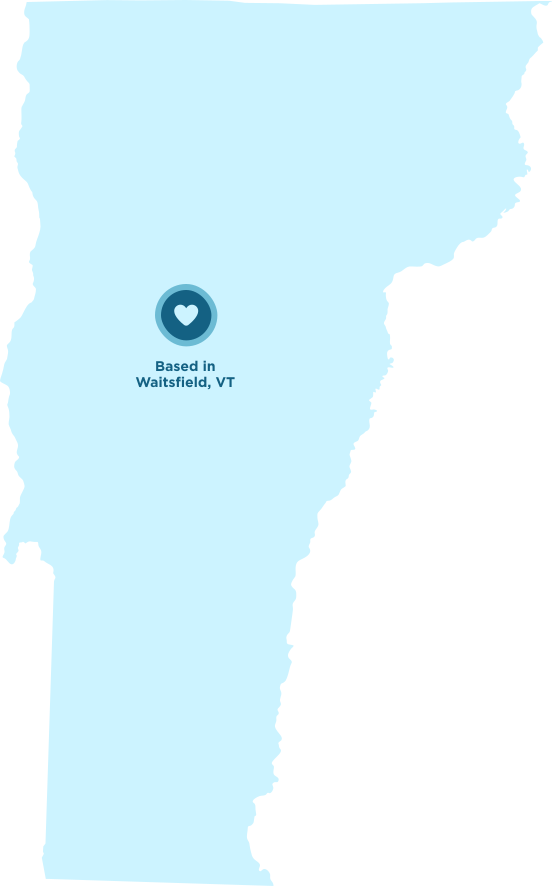
From our home base in Waitsfield, VT, we provide water treatment services throughout the Green Mountain State. Each community has its own water quality characteristics based on local geology and water sources - and after 45 years, we've tested thousands of wells across Vermont and understand the regional variations that affect which treatment approaches work best.
We're Here to Help
Hear From Your Neighbors

Bill Cherry
Switchback Brewing

Lindsay Kurrle
Community Relations Coordinator


Win Smith
President

Ken Bisceglio
Regional Manager

Let's Solve Your Iron Problem
Iron in your well water is a solvable problem. Clear Water Filtration has been removing iron from Vermont well water since 1980, and our team has seen virtually every combination of iron type, concentration, and co-contaminant that Vermont bedrock geology produces.
We start every iron removal project the same way: a free in-home water test that measures your actual iron level - and everything else that's in your water. From there, we recommend a system sized for your specific well, your household's water use, and your budget. No guessing, no overselling, no one-size-fits-all approach.
When you call us at 802-496-5544, you talk to a local team member - not a call center. We serve all of Vermont seven days a week and offer emergency service for urgent water quality issues.

© Red Barn Media Group 2026